
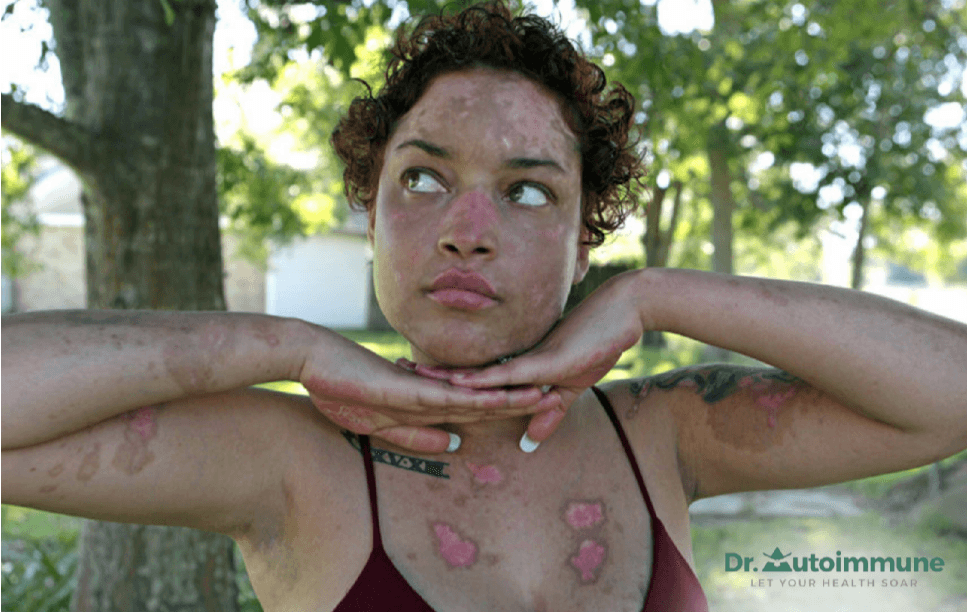
The skin is the largest organ of your body and will sometimes hint at what’s going on beneath
the surface when an individual is suffering from certain autoimmune conditions.
Did You Know?
The skin is made up of five distinct layers of skin, and the two top ones are most often affected
by autoimmune skin diseases.
The top layer is called the epidermis, and it is the outermost layer. The underlying layer is the
dermis, and it contains vital cells, tissues, and structures.
When either of these layers become compromised by an autoimmune disease it can cause
certain symptoms.
Symptoms Of Autoimmune Skin Diseases Can Include:
● Chronic fatigue
● Skin inflammation (swelling)
● Small patches of red, scaly skin
● Skin scarring
● Dry, cracked skin that may bleed or itch
● Thickened, pitted, and ridged nails
● Stiff and swollen joints
Causes
Autoimmune skin diseases occur because the body’s immune system attacks its own healthy
tissues.
When these antibodies attack healthy tissues, they are called autoantibodies.
With autoimmune skin conditions, autoantibodies attack skin cells or collagen tissues.
Triggers & Other Factors
Researchers link a variety of triggers for the development of these conditions, including
ultraviolet radiation (from the sun), hormones, infections, and certain foods.
Even some prescription drugs may play a part in the development of certain autoimmune
disorders.
Other factors can also play a role in autoimmune skin diseases- like stress! Stress can also
trigger autoimmune skin conditions.
Some researchers even think that some people have a genetic predisposition for certain
autoimmune skin diseases.
And people with specific genes also have an increased risk for developing particular skin
conditions- but only if other trigger factors exist.
What You’ve Learned So Far
So far you’ve learned about your skin and the different symptoms of an autoimmune condition.
You’ve also learned the causes & triggers of what could cause a flare up on your skin.
So now let’s go over a few of the most common autoimmune diseases that will show up on your
skin.
Common Autoimmune Diseases That Will Show Up On Your
Skin
LUPUS
● Also known as systemic lupus erythematosus (SLE), lupus is a chronic autoimmune
disease that can affect any part of the body. The most common symptom is inflammation
and it usually targets the joints, brain, kidneys, and the skin. It’s also been known to
cause joint pain and even arthritis.
Common symptoms are generally a butterfly-shaped rash on the face that covers the cheeks
and the bridge of the nose.
Sometimes individuals will have rashes elsewhere on the body, and will also cause the patient’s
skin to be hypersensitive to the sun. Even small amounts of sunlight can create scaly patches
across the skin that can scar over. It is these scarred sections of skin that have an increased
risk of developing carcinoma and melanoma, the two common forms of skin cancer.
SCLERODERMA
Localized Scleroderma is a chronic connective tissue disease that causes extreme hardening of
the skin, caused by vast overproduction of collagen.
This autoimmune skin condition is seen in only a few places on the skin and it seldom spreads.
In fact, it progresses relatively slow and affects the skin of the hands, feet, and face. It
sometimes can also damage the lungs, esophagus or intestines.
Diffuse Scleroderma is another form of this autoimmune disease and it can progress very
quickly, affecting the skin across the entire body.
DERMATOMYOSITIS
Dermatomyositis is a chronic disease that causes muscle inflammation, which often leads to
muscle weakness. It is one of a group of diseases known as inflammatory myopathies.
The first symptom of dermatomyositis is a skin rash that will appear on the eyelids, nail cuticle
areas, and/or on muscles that are used to straighten or extend joints including heels, elbows,
and knuckles. The rash is bluish-purple or red and is usually patchy.
PEMPHIGOID
This autoimmune disease results in skin rashes and fluid-filled blisters along the legs, arms,
stomach, or on the mucous membrane (this includes the mouth, eyes, nose, throat, and
genitals).
There are different types of pemphigoid, and they are characterized by where the blistering
occurs on the body.
Bullous Pemphigoid: Blistering happens on the arms and legs, mostly around the joints
Cicatricial Pemphigoid: Blistering occurs on the mucous membrane, typically affecting the eyes
and mouth.
Pemphigoid Gestationis: This is when the blistering occurs shortly after or during pregnancy,
usually on the arms, legs, and abdomen.
PEMPHIGUS
Pemphigus looks very similar to pemphigoid, as they are both characterized by blisters on the
skin and/or the mucous membrane.
The difference lies in the fact that the immune system attacks a different part of the skin in each
disease. The affected part of the skin in pemphigus is more fragile because it is closer to the
surface, so any blisters than form burst very easily. Patients that have this autoimmune disease
usually have visual signs of more ruptured blisters, and the individual is usually covered with
scabs.
Pemphigus is considered a more serious disease since burst blisters present a higher chance of
infection, which is dangerous for someone with an already compromised immune system.
There are two main types of pemphigus:
Pemphigus Vulgaris: Blisters begin in the mouth and spread to the skin or genitals. Generally,
these blisters are painful but not itchy.
Pemphigus Foliaceus: Blisters that appear on the chest, back, and shoulders. These are usually
more itchy than painful.
PSORIASIS
One of the more well-known autoimmune skin diseases is psoriasis.
This autoimmune condition speeds up the life cycle of skin cells, causing excess skin cells to
collect on the surface of the skin. This buildup forms itchy and painful scales and red patches.
There are many different types of psoriasis, but some common symptoms include:
● red patches of skin with silvery scales
● itchy scaling spots
● extremely dry skin that may bleed if it cracks
● swollen and stiff joints
Patches can range in size from a few smaller spots that can look like dandruff, to much larger
affected patches of skin.
Psoriasis typically goes through cycles, and patients will experience flare-ups for a short period
of time, and then go into remission.
See A Specialist
For Boulder, Colorado residents that are experiencing any of the symptoms or conditions
mentioned above seek the help of the best autoimmune doctor and team in the state- Dr. Ian
Hollaman and the Dr. Autoimmune team.
Click Here to learn more about the conditions we treat, and to view our New Patient Special!
Ready to Find Your Root Cause?
Book a discovery call and talk through your symptoms with our team, no obligation.
Book your Discovery Call